
In today’s fast-paced business environment, efficiency and productivity are paramount. Hiring a virtual assistant (VA) offers a strategic solution for entrepreneurs and businesses seeking to optimize operations and achieve significant growth. From streamlining administrative tasks to providing access to specialized skills, the advantages of employing a VA extend far beyond simple cost savings, impacting overall business success and even work-life balance.
This exploration delves into the multifaceted benefits of integrating a virtual assistant into your business model, examining the impact on productivity, cost-effectiveness, access to specialized expertise, and the overall improvement in work-life balance for business owners. We will explore how VAs contribute to scalability and flexibility, allowing businesses to adapt and thrive in dynamic markets.
Increased Productivity and Efficiency
Hiring a virtual assistant (VA) significantly boosts productivity by freeing up your time and allowing you to focus on strategic, high-value tasks that directly contribute to your business’s growth. Delegating routine administrative and operational duties to a VA allows you to concentrate on core competencies and ultimately achieve more in less time.Delegating administrative and operational tasks to a virtual assistant has a profound impact on overall productivity.
The time saved can be redirected towards activities that generate revenue, enhance client relationships, or develop innovative strategies. This shift in focus leads to improved efficiency and a greater return on investment.
Streamlining Workflows and Processes
A virtual assistant can effectively streamline workflows and processes by taking on a variety of tasks. They can manage schedules, handle email correspondence, create presentations, and perform data entry, freeing up your time for more critical business decisions. For example, a business owner who previously spent hours each week managing emails and scheduling appointments can now dedicate that time to developing new products or marketing campaigns.
Another example is a marketing manager who can delegate social media posting and content scheduling, allowing them to focus on developing and implementing comprehensive marketing strategies. This targeted approach maximizes the impact of the available time and resources.
Time Savings After VA Hiring
The following table illustrates the potential time savings after hiring a virtual assistant. These figures are illustrative and will vary depending on the specific tasks delegated and the individual’s workload.
| Task | Time Before VA (hours/week) | Time After VA (hours/week) | Time Saved (hours/week) |
|---|---|---|---|
| Email Management | 10 | 2 | 8 |
| Scheduling Appointments | 5 | 1 | 4 |
| Data Entry | 8 | 2 | 6 |
| Social Media Management | 7 | 1 | 6 |
| Report Generation | 6 | 2 | 4 |
Cost Savings and Reduced Expenses
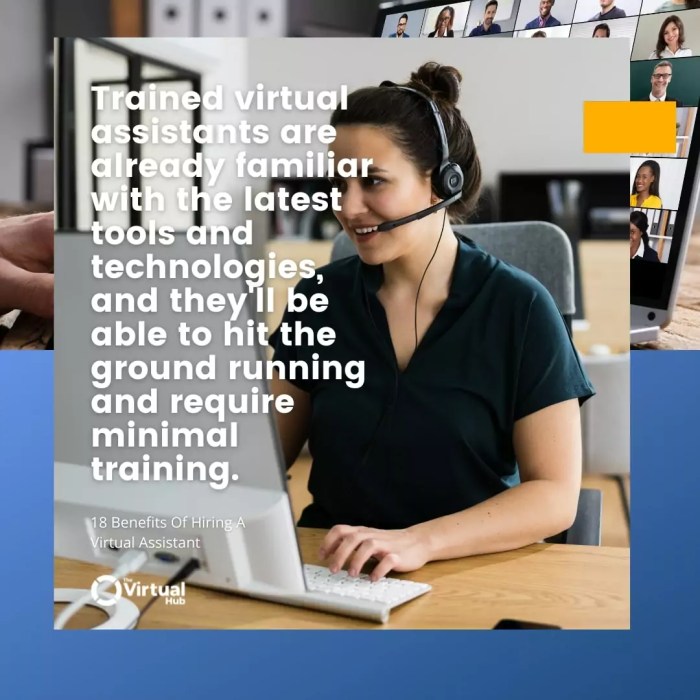
Hiring a virtual assistant offers significant financial advantages compared to employing a full-time employee. The cost-effectiveness stems from a reduction in overhead expenses and a flexible payment structure, ultimately leading to substantial savings for your business. This section will detail these savings and demonstrate how utilizing a virtual assistant can positively impact your bottom line.
The most significant cost savings arise from the elimination of expenses associated with traditional employment. Unlike full-time employees, virtual assistants don’t require the same level of investment in infrastructure, benefits, and payroll administration. This translates to a leaner operational budget and increased profitability.
Reduced Overhead Costs
Employing a virtual assistant dramatically reduces overhead expenses. Consider the significant costs associated with a full-time employee: office space, utilities, equipment, insurance, and employee benefits such as health insurance, paid time off, and retirement contributions. These costs can quickly accumulate, significantly impacting your budget. By contrast, a virtual assistant requires none of these, significantly reducing your overhead.
Specific Expense Reductions
Several specific expenses can be significantly reduced by employing a virtual assistant. For example, the costs associated with recruiting, training, and managing a full-time employee are eliminated. Similarly, expenses related to providing office space, equipment, and utilities are avoided. Moreover, the costs associated with employee benefits, including health insurance, paid time off, and retirement contributions, are completely eliminated.
The savings accumulate over time, representing a substantial return on investment.
Cost Comparison: Full-Time Employee vs. Virtual Assistant
| Expense Category | Full-Time Employee Cost (Annual Estimate) | Virtual Assistant Cost (Annual Estimate) | Savings |
|---|---|---|---|
| Salary | $50,000 | $15,000 | $35,000 |
| Benefits (Health Insurance, PTO, etc.) | $10,000 | $0 | $10,000 |
| Office Space & Utilities | $5,000 | $0 | $5,000 |
| Equipment (Computer, Software) | $2,000 | (Often provided by VA) | $2,000 (or more depending on VA agreement) |
| Payroll Taxes & Administration | $5,000 | $0 | $5,000 |
| Recruitment & Training | $3,000 | $0 | $3,000 |
| Total Annual Cost | $75,000 | $15,000 | $60,000 |
Note: These figures are estimates and can vary greatly depending on location, industry, and the specific tasks delegated to the virtual assistant. The savings shown represent a potential outcome and may differ in individual cases.
Access to Specialized Skills and Expertise
Hiring a virtual assistant provides businesses with on-demand access to a wide range of specialized skills, often at a fraction of the cost of hiring full-time employees with the same expertise. This allows companies to scale their operations efficiently and tackle projects requiring specific knowledge without significant long-term financial commitments. This flexibility is particularly beneficial for businesses experiencing fluctuating workloads or those needing assistance with specialized tasks outside their core competencies.Virtual assistants commonly offer a diverse skillset that can significantly enhance business operations.
The cost-effectiveness stems from the elimination of overhead expenses associated with full-time employees, such as salaries, benefits, and office space. The ability to leverage specialized skills on an as-needed basis contributes to improved efficiency and allows businesses to focus on their core strengths.
Cost Comparison: Specialists vs. Virtual Assistants
The cost of hiring a specialized professional, such as a graphic designer or social media manager, can vary significantly depending on experience and location. A full-time graphic designer, for instance, might command a salary of $50,000 to $80,000 per year or more, including benefits. In contrast, a virtual assistant offering graphic design services may charge hourly rates ranging from $25 to $75, depending on their expertise and the complexity of the project.
This significant difference in cost allows businesses, particularly small and medium-sized enterprises (SMEs), to access high-quality design work without the substantial financial commitment of a full-time employee. Similarly, a dedicated social media manager could cost a business upwards of $60,000 annually, while a virtual assistant specializing in social media management can provide services for a much lower hourly or project-based fee.
The cost savings are even more pronounced for tasks requiring only occasional assistance.
Specialized Virtual Assistant Skill Sets and Applications
Businesses of all sizes can benefit from the specialized skills offered by virtual assistants. A small startup might utilize a virtual assistant for social media management and basic administrative tasks, freeing up the founders to focus on product development and sales. A larger corporation might engage virtual assistants for data entry, market research, or customer service support, supplementing its existing workforce during peak periods or for specific projects.
The scalability and flexibility of virtual assistant services make them a valuable asset for businesses of all sizes, adapting to evolving needs and fluctuating workloads.
- Social Media Management: Creating and scheduling social media posts, engaging with followers, analyzing performance metrics. This can significantly increase brand awareness and customer engagement.
- Graphic Design: Creating logos, marketing materials, website graphics, and social media visuals. This improves the visual appeal of a company’s branding and marketing efforts.
- Data Entry: Entering data into spreadsheets, databases, and other systems. This streamlines data management and reduces manual effort.
- Customer Service: Responding to customer inquiries, resolving issues, and providing support. This enhances customer satisfaction and improves response times.
- Email Marketing: Creating and sending email newsletters, managing email lists, and tracking campaign performance. This improves communication and customer retention.
- Transcription Services: Converting audio or video recordings into text. This can be valuable for meetings, interviews, or presentations.
- Virtual Receptionist: Answering phone calls, scheduling appointments, and managing calendars. This frees up staff time and provides professional front-desk support.
- Web Development: Basic website maintenance, updates, and content management. This helps ensure a website remains functional and up-to-date.
Scalability and Flexibility
Hiring a virtual assistant offers unparalleled scalability and flexibility, allowing businesses to adapt their support structure to fluctuating workloads and evolving needs. This adaptability is a key advantage, enabling businesses to optimize resource allocation and maintain efficiency regardless of project size or seasonal demands.The inherent flexibility of virtual assistant services allows businesses to easily adjust their support levels. This means scaling up during peak periods or large projects, and scaling down during quieter times.
This dynamic approach prevents overspending on unnecessary resources while ensuring adequate support is always available when needed.
Examples of Scaling Virtual Assistant Support
The ability to scale virtual assistant support proves invaluable in various situations. For instance, a small e-commerce business might require minimal assistance during the off-season but significantly increase their virtual assistant’s hours during peak sales periods like Black Friday or the holiday season. Similarly, a marketing agency launching a major campaign could temporarily hire additional virtual assistants to handle increased email correspondence, social media management, and content creation, then reduce the number of assistants once the campaign concludes.
A growing startup might start with one virtual assistant handling basic administrative tasks and gradually add more as the company expands and requires specialized skills in areas like graphic design or social media marketing.
Advantages of Scalability and Flexibility with Virtual Assistants
The scalability and flexibility offered by virtual assistants translate directly into significant cost savings and increased operational efficiency. Businesses can avoid the overhead associated with hiring full-time employees, including benefits, office space, and equipment. The ability to adjust the scope of work and working hours allows for precise resource allocation, ensuring that businesses only pay for the services they actually need.
This dynamic approach optimizes costs and maximizes productivity, allowing businesses to focus on core competencies and strategic growth.
Ultimately, the decision to hire a virtual assistant represents a strategic investment in your business’s future. By delegating tasks effectively, you unlock increased productivity, significant cost savings, access to specialized skills, and a healthier work-life balance. The flexibility and scalability offered by virtual assistants empower businesses to adapt to changing demands and focus on core competencies, leading to enhanced efficiency and sustainable growth.
Consider the numerous benefits and how a VA can be a catalyst for your business’s success.
Commonly Asked Questions
What types of tasks can a virtual assistant handle?
Virtual assistants can handle a wide range of tasks, including scheduling appointments, managing emails, social media management, data entry, customer service, bookkeeping, and even content creation.
How do I find a reliable virtual assistant?
Several online platforms connect businesses with virtual assistants. Thorough vetting, including checking references and reviewing portfolios, is crucial. Clearly defining your needs and expectations beforehand is also essential.
What is the typical cost of hiring a virtual assistant?
The cost varies greatly depending on the VA’s experience, skills, and location. Hourly rates, project-based fees, and retainer agreements are common payment structures.
What if my needs change? Can I adjust my VA’s workload?
Yes, most virtual assistants offer flexible arrangements. You can usually scale their workload up or down as your business needs change.


