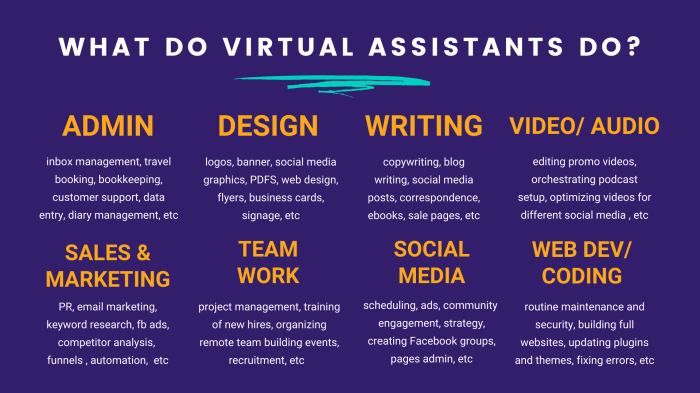
In today’s fast-paced world, the demand for efficiency and productivity is paramount. Enter the virtual assistant – a modern solution revolutionizing how businesses and individuals manage their workloads. Far from a simple administrative helper, virtual assistants offer a diverse range of skills and services, adapting to the unique needs of their clients. This exploration delves into the multifaceted world of virtual assistants, examining their roles, benefits, and the future of this ever-evolving profession.
Virtual assistants provide support across various sectors, from administrative tasks like scheduling and email management to more specialized roles in technical support, marketing, and customer service. They bridge the gap between individual needs and efficient task completion, offering a flexible and scalable solution for businesses of all sizes, and even individual professionals seeking to optimize their time and focus.
Definition of a Virtual Assistant
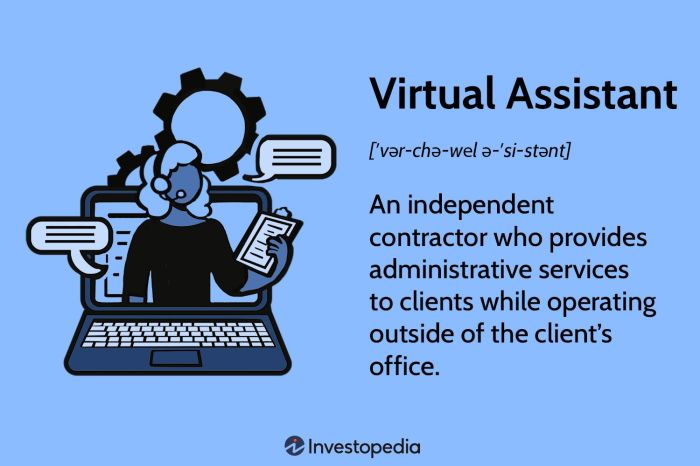
A virtual assistant (VA) is an independent contractor who provides administrative, technical, or creative assistance to clients remotely. They operate from a home office or other location, utilizing technology to communicate and complete tasks. This differs from traditional in-office support staff as VAs are not directly employed by the client and offer flexible, scalable support.The key characteristics differentiating virtual assistants from other support roles lie in their independent contractor status, remote work arrangement, and specialized skill sets.
Unlike employees, VAs manage their own schedules, taxes, and business operations. Their remote nature allows them to serve clients across geographical boundaries, and their specialized skills often focus on specific areas of expertise, offering a more targeted and efficient support system than a generalist administrative assistant might provide.
Types of Virtual Assistants
Virtual assistants offer a wide range of services, leading to various specializations. This allows businesses to access specialized expertise without the commitment of a full-time employee. The most common types of virtual assistants include administrative, technical, and customer service VAs.Administrative virtual assistants handle tasks such as scheduling appointments, managing emails, making travel arrangements, and preparing presentations. They often act as a client’s right-hand person, managing their day-to-day operations and freeing up their time to focus on core business activities.
For example, an administrative VA might manage the calendar of a busy entrepreneur, ensuring all meetings are scheduled efficiently and reminders are sent.Technical virtual assistants provide support related to technology. This might involve website maintenance, social media management, data entry, or troubleshooting technical issues. A technical VA could, for instance, help a small business set up and manage their email marketing campaigns or troubleshoot problems with their website.Customer service virtual assistants handle interactions with clients, answering questions, resolving issues, and providing support.
They are often the first point of contact for customers, ensuring a positive and efficient experience. An example would be a customer service VA handling online inquiries for an e-commerce business, answering questions about products and processing orders.
Tasks Performed by Virtual Assistants
Virtual assistants (VAs) offer a wide range of services, significantly boosting productivity and efficiency for individuals and businesses alike. Their adaptability allows them to handle tasks across various sectors, from administrative support to technical assistance and customer service interactions. The specific tasks undertaken depend largely on the client’s needs and the VA’s skillset.
Administrative Tasks Handled by Virtual Assistants
Virtual assistants frequently manage a variety of administrative duties, freeing up their clients to focus on core business activities. These tasks often involve scheduling, communication management, and data organization. Effective administrative support is crucial for maintaining a well-organized and efficient workflow.
| Task Category | Specific Task | Tools Used | Benefits |
|---|---|---|---|
| Scheduling & Calendar Management | Appointment scheduling, meeting coordination, calendar maintenance | Google Calendar, Outlook Calendar, scheduling software | Reduced scheduling conflicts, improved time management, increased efficiency |
| Communication Management | Email management, phone calls, social media management | Email clients, CRM software, social media platforms | Improved communication flow, enhanced response times, consistent brand messaging |
| Data Entry & Organization | Data entry, file organization, database management | Spreadsheet software (Excel, Google Sheets), database software | Improved data accuracy, streamlined data access, enhanced data analysis capabilities |
Technical Tasks Performed by Virtual Assistants
Beyond administrative duties, many VAs possess technical skills enabling them to assist with various technological tasks. This often involves website maintenance, data analysis, and software support. Proficiency in these areas is increasingly valuable in today’s digital landscape.
| Task Category | Specific Task | Tools Used | Benefits |
|---|---|---|---|
| Website Maintenance | Content updates, optimization, plugin management | WordPress, website builders, tools | Improved website performance, enhanced online visibility, increased user engagement |
| Data Analysis | Data cleaning, data visualization, report generation | Spreadsheet software, data visualization tools, statistical software | Data-driven decision-making, improved business insights, enhanced strategic planning |
| Software Support | Troubleshooting, software installation, training | Various software applications, online resources | Improved software functionality, reduced downtime, increased user productivity |
Customer Service Tasks Undertaken by Virtual Assistants
Virtual assistants can play a crucial role in providing excellent customer service. They can handle inquiries, resolve issues, and manage customer communications, contributing significantly to customer satisfaction.
| Task Category | Specific Task | Tools Used | Benefits |
|---|---|---|---|
| Inquiry Handling | Responding to customer emails, answering phone calls, live chat support | Email clients, CRM software, live chat platforms | Improved response times, enhanced customer satisfaction, increased customer loyalty |
| Issue Resolution | Troubleshooting customer problems, providing technical support, processing refunds | CRM software, help desk software, payment processing systems | Faster problem resolution, improved customer experience, reduced customer churn |
| Communication Management | Sending follow-up emails, managing customer feedback, social media monitoring | Email clients, CRM software, social media platforms | Improved communication flow, enhanced brand reputation, increased customer engagement |
Benefits of Using a Virtual Assistant
Employing a virtual assistant offers a multitude of advantages for businesses of all sizes, impacting operational efficiency, cost management, and overall productivity. The flexibility and scalability of virtual assistance make it a compelling option in today’s dynamic business environment.The advantages of utilizing virtual assistants are numerous and far-reaching, affecting various aspects of a business’s operation. From streamlining administrative tasks to providing specialized support, virtual assistants offer a cost-effective and efficient solution to enhance productivity and free up valuable time for core business activities.
Cost-Effectiveness of Virtual Assistants
Hiring a virtual assistant is often significantly more cost-effective than employing a full-time employee. Businesses avoid expenses associated with salaries, benefits (health insurance, paid time off, retirement contributions), office space, and equipment. The hourly or project-based payment structure of virtual assistants allows for flexible budgeting and scaling resources based on workload demands. For example, a small business owner might only need assistance during peak seasons, avoiding the financial burden of a year-round salary.
In contrast, a full-time employee necessitates consistent salary expenditure regardless of workload fluctuations. This makes virtual assistants particularly attractive for startups and small businesses with limited budgets. Larger companies can also benefit, using virtual assistants for specific projects or to supplement existing staff during periods of high demand, reducing the need for permanent hiring and associated overhead.
Impact on Productivity and Efficiency
Virtual assistants significantly boost productivity and efficiency by handling administrative, technical, or creative tasks, freeing up business owners and employees to focus on strategic initiatives and core competencies. This delegation of tasks leads to increased output, improved time management, and reduced operational bottlenecks. For instance, a virtual assistant can manage scheduling, email correspondence, social media updates, and data entry, allowing business owners to dedicate more time to client interaction, product development, or sales.
The result is a more streamlined workflow, enhanced operational effectiveness, and improved overall business performance. The accessibility and responsiveness of virtual assistants also contribute to enhanced efficiency; tasks can be completed quickly and effectively, minimizing delays and improving response times to clients and stakeholders.
Case Study: Small Business Success with a Virtual Assistant
Sarah, the owner of a small bakery, struggled to manage her growing online orders and social media presence alongside baking and customer service. She hired a virtual assistant to handle online order processing, respond to customer inquiries, and manage her social media accounts. Within three months, Sarah saw a 20% increase in online orders, a 15% improvement in customer response times, and a significant increase in her social media engagement.
The virtual assistant’s efficient management of these tasks allowed Sarah to focus on her core competency – baking – resulting in increased productivity, improved customer satisfaction, and ultimately, higher profits. This demonstrates how a strategic investment in a virtual assistant can yield substantial returns for small businesses.
Skills and Qualities of Effective Virtual Assistants
Effective virtual assistants possess a blend of technical proficiency and interpersonal skills that enable them to manage diverse tasks efficiently and effectively. Their success hinges on a combination of hard skills, easily learned and demonstrable abilities, and soft skills, more nuanced traits that reflect personality and approach. The right mix of both is crucial for providing exceptional virtual assistant services.
Essential Hard Skills for Virtual Assistants
Proficiency in a range of technical skills is paramount for virtual assistants. These skills directly impact their ability to complete tasks efficiently and accurately. Lacking these core competencies would significantly hinder their performance.
- Proficient in Microsoft Office Suite (Word, Excel, PowerPoint, Outlook): This forms the foundation for many administrative tasks, from document creation and spreadsheet management to presentation design and email communication.
- Strong Typing Skills and Accuracy: Speed and accuracy are essential for high-volume tasks such as email management and document preparation.
- Experience with Scheduling and Calendar Management Software (Google Calendar, Outlook Calendar): Efficient scheduling is vital for managing appointments and deadlines for themselves and their clients.
- Proficiency in CRM Software (e.g., Salesforce, HubSpot): Many virtual assistants work with client relationship management systems, requiring expertise in data entry, reporting, and customer interaction management.
- Social Media Management Skills (various platforms): Many virtual assistants manage social media accounts for their clients, requiring knowledge of posting strategies, engagement, and analytics.
- Basic Web Development Skills (HTML, CSS): While not always required, basic web development skills can be advantageous for tasks involving website updates or simple content creation.
Crucial Soft Skills for Virtual Assistants
While hard skills provide the technical foundation, soft skills determine a virtual assistant’s ability to interact effectively with clients and colleagues. These interpersonal skills are crucial for building strong working relationships and delivering exceptional service.
- Excellent Communication Skills (written and verbal): Clear, concise, and professional communication is essential for understanding client needs, providing updates, and resolving issues.
- Exceptional Organizational and Time Management Skills: Juggling multiple tasks and meeting deadlines requires meticulous organization and effective time management techniques.
- Adaptability and Flexibility: The ability to adapt to changing priorities and unexpected challenges is critical in a dynamic work environment.
- Problem-Solving Skills: Virtual assistants frequently encounter unexpected problems; the ability to identify solutions and take initiative is crucial.
- Proactive and Self-Motivated: A proactive approach allows virtual assistants to anticipate needs and take initiative, while self-motivation ensures consistent high performance.
- Professionalism and Discretion: Maintaining confidentiality and projecting a professional image is essential for building trust with clients.
Importance of Communication and Time Management
Effective communication is the cornerstone of any successful virtual assistant-client relationship. Clear and concise communication ensures that tasks are understood, expectations are aligned, and potential issues are addressed promptly. Time management skills are equally crucial; virtual assistants often juggle multiple projects and deadlines, requiring the ability to prioritize tasks, manage their time effectively, and meet commitments consistently. For example, a virtual assistant might need to manage a client’s social media, schedule meetings, and prepare reports, all within a single workday.
Effective time management ensures all tasks are completed to a high standard without compromising on quality.
Adaptability and Problem-Solving Abilities
The ability to adapt to changing circumstances and solve problems independently is crucial for virtual assistants. Clients’ needs can change unexpectedly, requiring the virtual assistant to adjust their schedule and priorities. For instance, a client might need a presentation prepared urgently, requiring the virtual assistant to reschedule other tasks and work efficiently under pressure. Problem-solving skills allow the virtual assistant to identify solutions to unexpected issues, ensuring smooth workflow and client satisfaction.
This might involve troubleshooting technical difficulties, finding alternative solutions to a problem, or resolving a conflict between different clients’ requests.
Tools and Technologies Used by Virtual Assistants
Virtual assistants rely on a diverse range of tools and technologies to effectively manage their workload and deliver high-quality services to their clients. These tools span project management, communication, scheduling, and cloud storage, all contributing to increased efficiency and seamless collaboration. Proficiency in these technologies is crucial for success in this dynamic field.
Project Management Tools
Efficient project management is essential for virtual assistants. Various tools help organize tasks, track progress, and collaborate with clients and teams. The choice of tool often depends on the complexity of projects and client preferences.
| Tool | Features | Strengths | Weaknesses |
|---|---|---|---|
| Asana | Task management, project timelines, team collaboration, file sharing | Intuitive interface, robust features, free plan available | Can be overwhelming for simple projects, limited reporting features in free plan |
| Trello | Kanban boards, task organization, workflow visualization, integrations | Visual and easy to understand, flexible, excellent for collaborative projects | Limited reporting capabilities, can become cluttered with many projects |
| Monday.com | Highly customizable workflows, automation features, time tracking, reporting | Powerful automation, comprehensive reporting, excellent for complex projects | Steeper learning curve, can be expensive for smaller teams |
| Notion | All-in-one workspace: notes, wikis, databases, project management | Highly customizable, integrates various functionalities, excellent for personal and team use | Can be overwhelming for new users, requires time to set up effectively |
Communication Tools
Effective communication is the cornerstone of any virtual assistant’s success. A range of tools facilitates seamless interaction with clients and colleagues.Email remains a primary communication channel for formal correspondence and document sharing. Instant messaging platforms like Slack or Microsoft Teams enable quick exchanges and real-time collaboration, particularly beneficial for urgent matters or quick questions. Video conferencing tools such as Zoom or Google Meet facilitate face-to-face interactions, enhancing communication clarity and building stronger client relationships.
The choice of tool often depends on the communication style preferred by the client and the urgency of the matter.
Scheduling and Calendar Management Tools
Efficient time management is paramount for virtual assistants juggling multiple clients and tasks. Scheduling and calendar management tools are crucial for optimizing workflows and preventing scheduling conflicts.Tools like Google Calendar, Outlook Calendar, or Calendly allow for easy scheduling of appointments, setting reminders, and managing time effectively. These tools often integrate with other platforms, streamlining the scheduling process and reducing the risk of double-booking or missed appointments.
Features such as automated reminders and time zone adjustments are especially valuable when working with clients in different locations.
Cloud Storage and Collaboration Platforms
Secure and accessible storage of client data and project files is essential. Cloud storage and collaboration platforms provide a centralized location for all relevant information, facilitating easy access and seamless collaboration.Platforms like Google Drive, Dropbox, or Microsoft OneDrive offer secure storage and sharing capabilities. These platforms also frequently integrate with other tools, allowing for streamlined workflows. The ability to share files securely and collaboratively with clients is a key advantage, fostering transparency and efficient project management.
Version control features within these platforms also help track changes and prevent data loss.
The Future of Virtual Assistants
The rapid advancement of artificial intelligence (AI) is poised to significantly reshape the landscape of the virtual assistant profession. While some tasks may be automated, the core role of the virtual assistant will likely evolve, demanding new skills and creating exciting new opportunities. The coming years will witness a fascinating interplay between human expertise and AI capabilities, ultimately leading to a more efficient and sophisticated virtual assistant industry.The integration of AI will undoubtedly impact the tasks performed by virtual assistants.
AI-powered tools are already automating repetitive tasks such as scheduling appointments, managing emails, and basic data entry. This automation will free up virtual assistants to focus on more complex and strategic tasks requiring human judgment, creativity, and emotional intelligence. This shift will lead to a higher demand for virtual assistants with specialized skills in areas like project management, content creation, and advanced client communication.
Impact of Artificial Intelligence
AI will not replace virtual assistants entirely; instead, it will augment their capabilities. AI-powered tools will handle routine tasks, allowing virtual assistants to concentrate on higher-value activities requiring critical thinking and problem-solving. For instance, instead of manually scheduling appointments, a virtual assistant might use an AI-powered calendar management system that proactively suggests optimal meeting times based on various factors, allowing the assistant to focus on complex project coordination.
This symbiotic relationship between human and AI will increase efficiency and productivity.
Evolution of Virtual Assistant Roles
The virtual assistant role will evolve from primarily administrative support to encompass more strategic and specialized functions. We can expect to see a rise in virtual assistants specializing in specific industries or niches, such as virtual assistants for e-commerce businesses focusing on social media management and customer service, or virtual assistants for healthcare professionals specializing in patient communication and appointment scheduling.
The demand for virtual assistants with expertise in data analysis, digital marketing, and content creation will also increase. Companies like Amazon, with its virtual assistant Alexa, already demonstrate this trend toward specialization, integrating AI with human-guided services.
Emerging Trends and Technologies
Several emerging trends and technologies will significantly influence the future of virtual assistant services. Natural Language Processing (NLP) will continue to improve, enabling more natural and intuitive interactions between virtual assistants and clients. The rise of hyperautomation will streamline even more processes, allowing virtual assistants to focus on higher-level tasks. Blockchain technology could also play a role in enhancing security and transparency in virtual assistant services.
The increasing prevalence of remote work will continue to fuel the demand for skilled virtual assistants. For example, the use of sophisticated project management software integrated with AI-powered communication tools will enhance the efficiency and effectiveness of virtual assistants in remote teams.
Automation’s Effect on Virtual Assistant Tasks
Automation will fundamentally alter the types of tasks performed by virtual assistants. Repetitive and data-heavy tasks, such as data entry, email filtering, and basic scheduling, will be increasingly automated. This shift will necessitate a focus on upskilling and reskilling for virtual assistants. They will need to develop advanced skills in areas like strategic planning, creative content generation, complex problem-solving, and client relationship management to remain competitive.
The focus will shift from task execution to strategic thinking and problem-solving. For example, instead of simply transcribing meeting notes, a virtual assistant might be responsible for analyzing those notes, identifying key action items, and distributing them to relevant stakeholders.
Ultimately, the rise of the virtual assistant reflects a broader shift towards flexible and remote work arrangements. Their adaptability, diverse skill sets, and cost-effectiveness make them an invaluable asset in today’s dynamic business landscape. As technology continues to evolve, the role of the virtual assistant is poised for further expansion, promising even greater efficiency and productivity gains in the years to come.
The future is bright for both businesses utilizing their services and the skilled professionals providing them.
FAQs
How much does a virtual assistant typically cost?
Pricing varies widely depending on experience, specialization, and location. Hourly rates can range from $15 to $100 or more.
What is the difference between a virtual assistant and a personal assistant?
While both provide support, personal assistants typically work directly for one individual, often managing personal tasks. Virtual assistants often work with multiple clients and focus on business-related tasks.
Do I need a contract when hiring a virtual assistant?
Yes, a written contract is highly recommended to Artikel responsibilities, payment terms, and confidentiality agreements.
How do I find a reliable virtual assistant?
Utilize online platforms like Upwork, Fiverr, and virtual assistant agencies. Thoroughly vet candidates through interviews and background checks.


